Ready, finally, for a final round of edits before I send it off to a very fine publisher with whom I will be overjoyed to publish, if they accept it. If not, it will be on to the next, and the next…
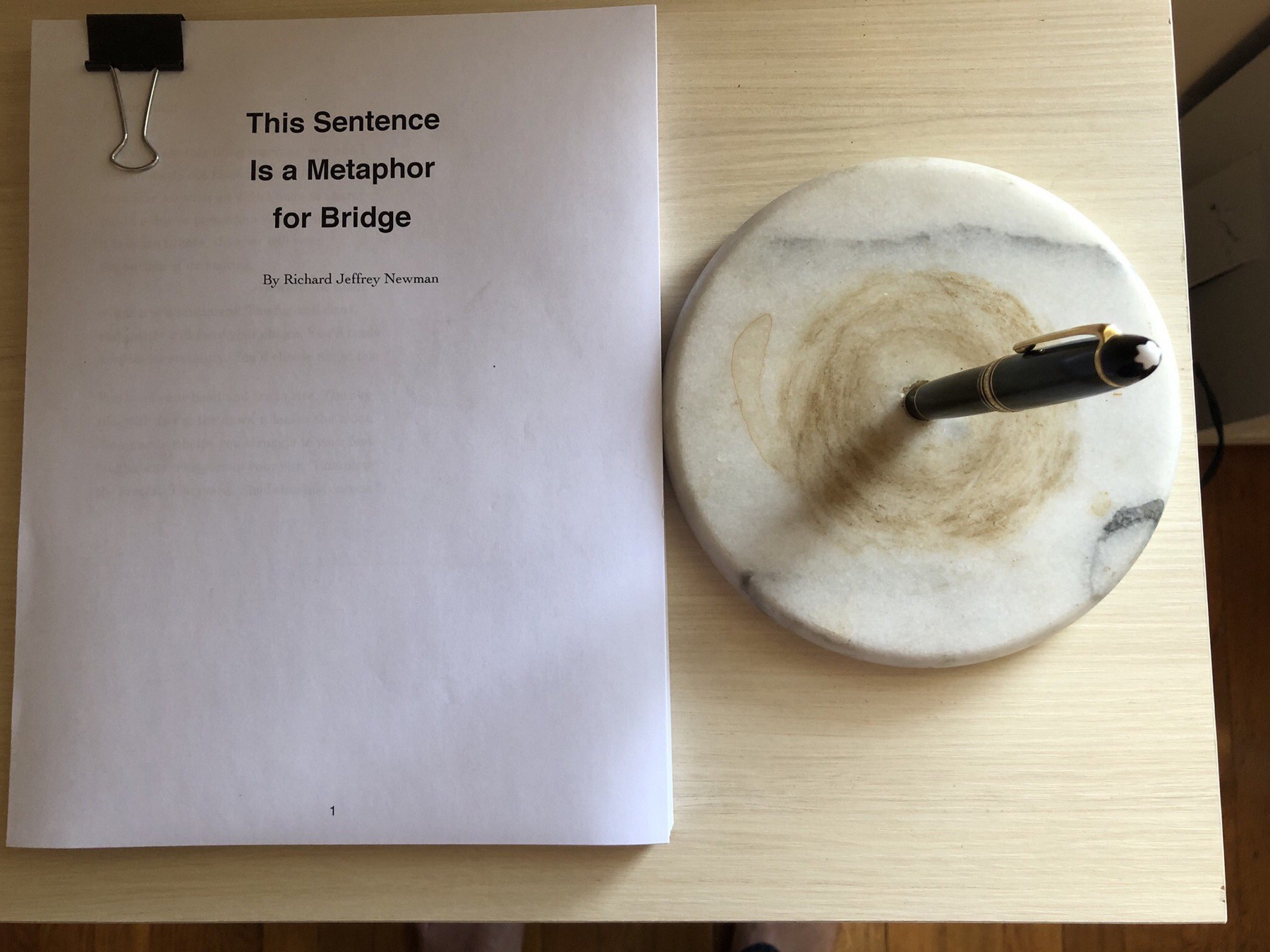
Ready, finally, for a final round of edits before I send it off to a very fine publisher with whom I will be overjoyed to publish, if they accept it. If not, it will be on to the next, and the next…
ELP’s Pirates. Been a long time since I’ve heard it and this live performance just made me happy.
Why are conclusions/endings–I’m thinking about essays here in particular–always so damned hard to write?
Well this is sobering: Axios Future: Special report — Surveillance capitalism
Newsletter Issue 7 is out. One highlight: Ayelet Rose Gottlieb has set my poem “Light” to music. It’s lovely.
Okay, sometimes satire is necessary and this made me laugh out loud in a couple of places: Every NIMBY’s Speech At A Public Hearing

I’ve been going through some old files and links and I came across this lovely open letter that someone wrote to me after the publication of my first book. It touched me then, and it touched me again today when I reread it.
THE SILENCE OF MEN: AN OPEN LETTER TO RICHARD JEFFREY NEWMAN
Dear Richard,
Just as I finished reading The Silence of Men (CavanKerry Press, 2006) a new friend confided that he’d learned a secret about his father—a secret that shook the foundation on which he’d built his life. He said he wanted to write about it, but didn’t know where to start. I recommended your book. In particular, the poem “After the Funeral.”
After the Funeral
That night, again, I dreamed you were leaving,
but this time I was older, and when I walked you
through the marketplace, and you put down
your suitcase to embrace me, I drew
the silence of all the years you’d been dead to me
around my grief. I wished you gone
and you were. In photographs, I see you
feeding me, your face younger than mine now.
In one, I’m a small bundle on your shoulder,
and the flat of your palm is the world against my back,
teaching me to let go of what is useless. You
have been useless to me. You never knew
the red shepherd I threw my Frisbee for.
In my mind, I matched him stride for stride,
and when he leapt to snatch the floating disc from air,
he called to me and we sailed off, a boy
who could run with wolves, a dog with language
and the gift of flight. I named him Larry,
after you, but true names are secrets,
so I called him Joe.
The metaphorical image of the boy playing Frisbee with his “red shepherd” is poignant and heart-breaking. The poem expresses the paradoxical feelings one has about a loved one who has betrayed them, feelings one will struggle with for a lifetime. The various manifestations of these feelings are well-represented in the poems “Again” and “The Silence of Men.”
I also appreciate the tenderness the speaker shows himself in “After the Funeral,” despite the pain he’s suffered because of his father. This tenderness towards oneself allows, it seems to me, one to feel real empathy for others. In “What I Carry with Me” you write about a friendly conversation between a Sikh cabbie and his Jewish fare, and the tension that rises between them when the cabbie is told the fare’s wife is Muslim. At the end of the ride, the speaker/fare transcends the incident, saying “and because I could imagine/surviving deaths that transformed me//into him, I tipped the driver anyway,/and he said thank you/and I wished him peace.”
This empathy makes authentic your many fine persona poems in this collection, such as “Rachel’s Story” and “Ibrahim’s Story.” In the first, you write in the voice of a female Holocaust survivor, wondering how it was she lived when her daughter and son died: “I’d chosen life. Or had it chosen me?” The second poem is spoken in the voice of a Palestinian man, living in exile in Bethlehem, nostalgic for the times he shared Erev Shabbat dinners with his Jewish friends, “in the years before there was a Jewish State.”
You’ve explored varied and difficult terrain in The Silence of Men and this reader is grateful for your courage. Throughout, I was reminded of Muriel Rukeyser’s The Life of Poetry (Paris Press, 1996), in which she wrote:
“A poem does invite, it does require. What does it invite? A poem invites you to feel. More than that: it invites you to respond. And better than that: a poem invites a total response. This response is total, but it is reached through the emotions. A fine poem will seize your imagination intellectually—that is, when you reach it, you will reach it intellectually too—but the way is through emotion, through what we call feeling.”
As I was preparing to post this piece, I received an e-mail from the friend I recommended read your book. He had this to say: “I LOVE IT!…his ability to communicate feelings is precisely what I’m hoping to be able to do. It’s great reading.”
I thoroughly enjoyed reading, and thinking about, your poems.
Shawn
It’s Taken 5 Decades to Get the Ph.D. Her Abusive Professor Denied Her
A rabbi’s Twitter thread apropo Alabama’s newcabortion law: “Call it Christian theocracy, which it is.” twitter.com
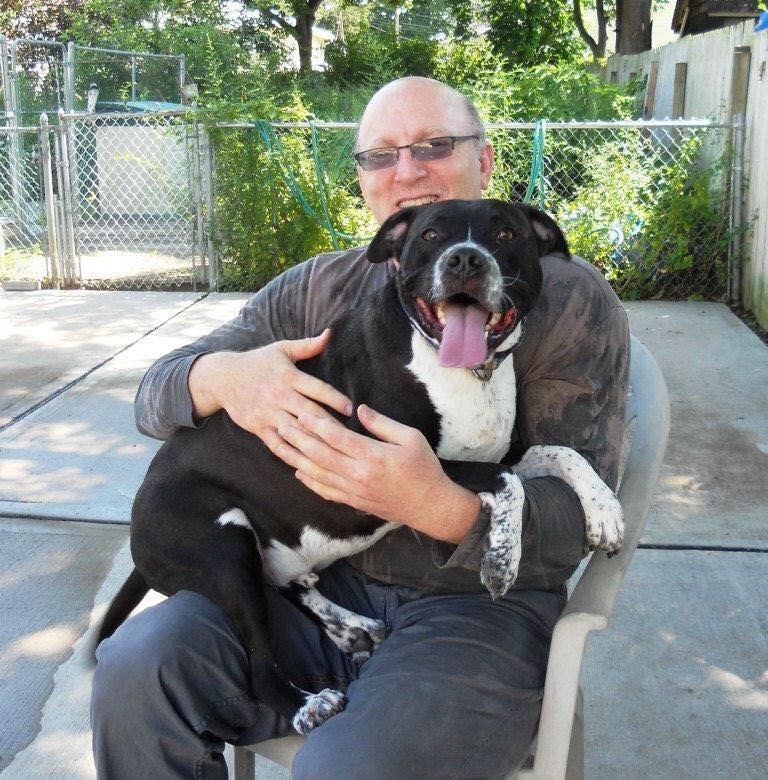
Me and Mikey, whom my mother had to have put down because he broke a knee and the complications were such that there really wasn’t any other choice. He lived with her, but he was my dog. I miss him every time I go to visit her.
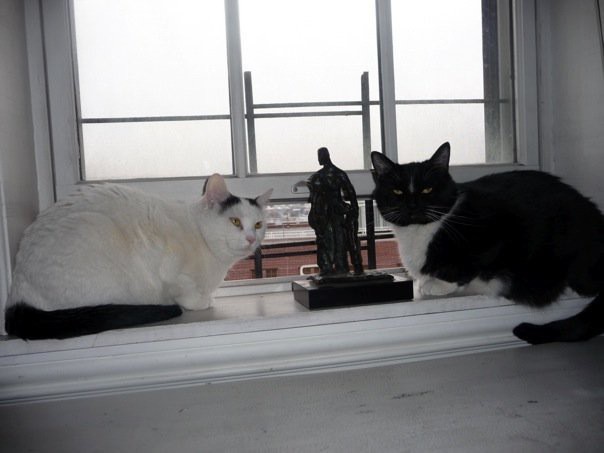
Mother and daughter, though the mother–on the right–is long gone. For some reason, they both liked that sculpture, by my great aunt Gussie Zinkow—who, I understand, has work in a museum somewhere in Georgia. Maybe in Atlanta
I just published my newsletter: #NationalPoetryMonth, #MeToo, Leaving Neverland, and Sexual Assault Awareness Month (#SAAM)—All In The Same Post
A Tale of Two Cancelled Speeches: Beloit and Columbia - ACADEME BLOG
The Moroccan Exception in the Arab World: Morocco’s efforts to reconnect with Moroccan Jews and their history.
An interesting tweet about Israeli Arab and Israeli Jewish attitudes towards coexisting in Israel.
Oy! Conservative Professor Sues State Senator Over Blog Post - ACADEME BLOG
"My mother is this mourning mother who begged
the staff to search for her daughter, but was denied.
Black mothers are often seen pleading for their children,
shown stern and wailing, held back somehow by police
or caution tape—
a black mother just wants to see her baby’s body.
a black mother just wants to cover her baby’s body
with a sheet on the street. A black mother
leaves the coffin open for all the world to see,
and my mother is no different. She is worried
about seeing the last minutes of me: pre-ghost,
stumbling alone through empty hotel hallways
failing to find balance, searching for a friend,
a center, anyone, to help me home. Yes."
Read this poem.
Barbara Streisand’s comments about Leaving Neverland are tone deaf at best and seem to justify or normalize pedophilia at worst.